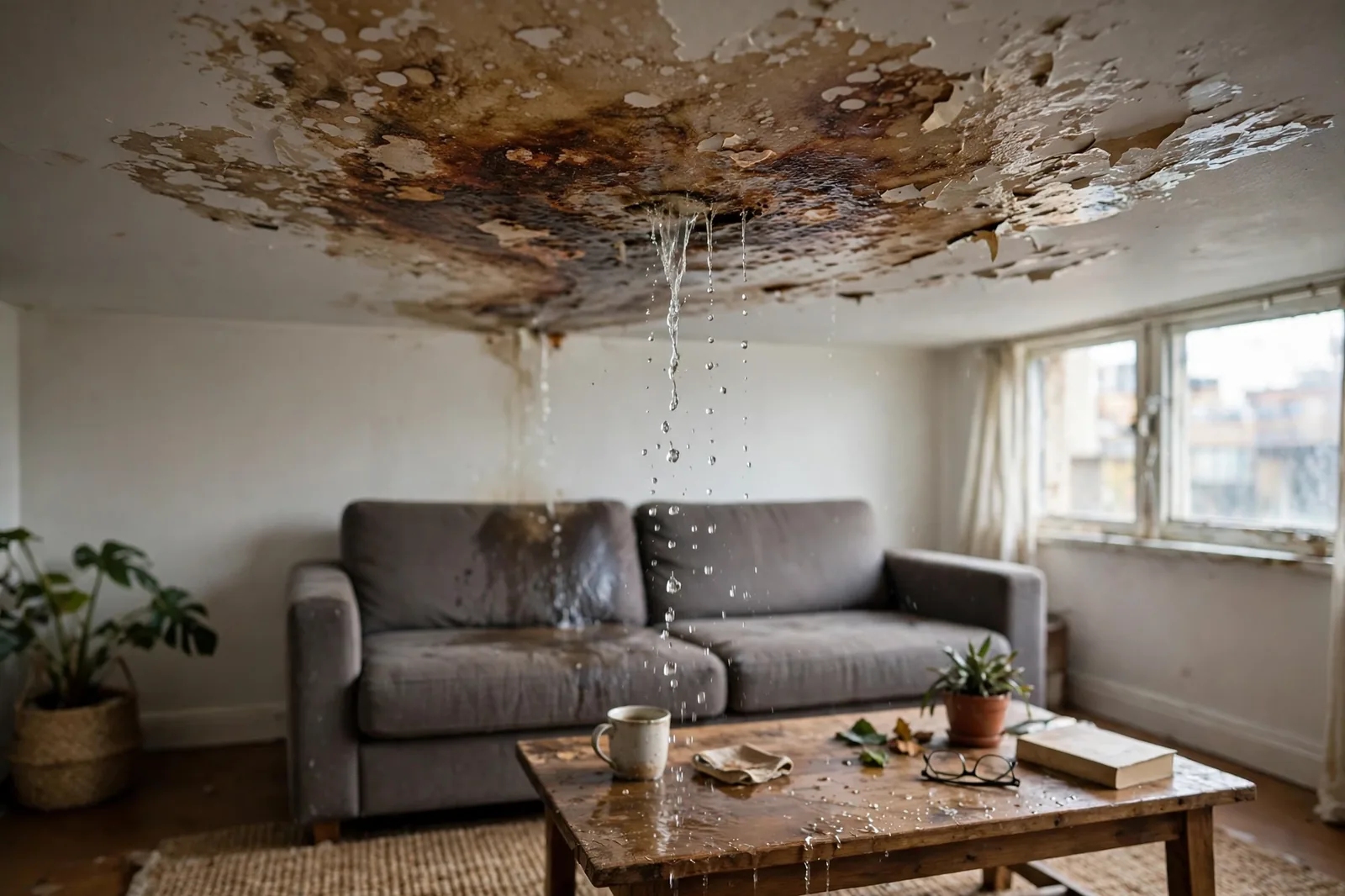
UNIT-TO-UNIT LEAKS • MIDVALE, UTAH
Upstairs Unit Leaked Into Yours? Who Pays in a Utah Condo or Apartment
In most Utah condos and townhomes, who pays depends on where the leak started and what your HOA's governing documents say. The HOA master policy often covers shared structure, each owner's HO-6 covers their unit's interior, and renters need their own policy for belongings. Drying should start before anyone settles who pays.
Who pays when an upstairs neighbor's leak damages my Utah condo?
It depends on where the leak began, your HOA's governing documents and each party's policy; the HOA master policy and owners' HO-6 policies often split the cost.
Unit-to-unit leaks are some of the most confusing water damage situations, because three or four parties can be involved at once: the owner of the unit where the leak started, the owner of the unit below, any renters living in either unit, and the HOA. Each has a different insurance policy covering a different part of the building. Utah's Condominium Ownership Act and your community's declaration (often called the CC&Rs) set the ground rules for who owns what and how the master policy deductible is handled. Because every community writes its documents a little differently, there's no single answer that fits every building. What is always true: the faster the water is removed and the better the damage is documented, the easier every part of the claim becomes.
What to Do First When Water Comes From Above
- Stop the water if you can. Knock on the door of the unit above. If no one answers, call the property manager or HOA emergency line.
- Protect yourself and your belongings. Turn off power to the wet room if water is near lights or outlets, and move electronics and furniture out of the way.
- Document everything. Take photos and video of the ceiling, walls, floor and damaged belongings, with the date.
- Notify the right people. Tell the HOA or property manager, the upstairs owner or tenant, your landlord if you rent, and your own insurance company.
- Start drying. Don't wait for everyone to agree on who pays. Water keeps spreading and the damage grows each day. Condo & Apartment Water Damage
- Keep a written log of who you spoke to, when, and what was said.
The Three Policies Involved
The HOA Master Policy
The HOA's master policy covers the parts of the building the association is responsible for. Depending on the community, that may be just the exterior and common areas (sometimes called "bare walls"), or it may also include original interior finishes like drywall, cabinets and flooring. The master policy usually has a deductible, and many associations can pass part or all of that deductible to the owner whose unit caused the loss.
The Owner's HO-6 Policy
An HO-6 is a condo owner's policy. It covers the parts of the unit the owner is responsible for under the HOA documents, along with personal belongings and liability. Two parts matter most for leaks:
- Dwelling or "walls-in" coverage for interior finishes the master policy doesn't cover.
- Loss assessment coverage, which can help pay an HOA deductible or special assessment charged to you.
The Renter's Policy
Renters don't own the walls, floors or fixtures, so neither the HOA's policy nor the landlord's policy covers their belongings. A renters policy covers personal property, and often temporary housing costs if the unit can't be lived in. If you rent and don't have a policy, the cost of replacing your belongings usually falls to you.
A General Guide to Who Covers What
Every community is different, so always check your governing documents and policies. This table shows how responsibility often splits.
| Where the water came from | Often covered by | What to know |
|---|---|---|
| A pipe inside a shared wall or ceiling | HOA master policy | The deductible may be charged to an owner in some cases |
| The roof, exterior or a common area | HOA master policy | Applies to water entering through building components |
| A washer, dishwasher, toilet or sink in the unit above | Upstairs owner, often through HO-6 | Damage below may still go through the master policy first |
| A shared drain stack backup | Depends on the cause | Lower units are usually hit hardest |
| Your belongings as a renter | Your renters policy | Not covered by the HOA or landlord |
| Your belongings as an owner | Your HO-6 | Under the personal property part of the policy |
What If the Upstairs Neighbor Was Careless?
If the leak came from something the upstairs owner or tenant did or failed to do, such as leaving a tub running or ignoring a dripping supply line, their liability coverage may come into play. In practice, your own insurer often pays your claim first and then seeks repayment from the other party's insurer. That process is called subrogation, and it's one reason to report the loss to your own insurer even when you're sure the other party is at fault.
Why Good Records Matter So Much
In a single-family home, there's one owner and one policy. In a condo or apartment building, the same leak can touch several policies, and each adjuster wants to know exactly what was damaged in the part they cover. Clear records make that possible:
- Separate photos for each unit, labeled with the unit number.
- Moisture readings showing how far water traveled in each unit.
- A list of removed materials by unit and room.
- Notes on the source, including where the water started and when it was found.
- Separate lists of tenant belongings and owner-owned items.
That's the kind of documentation we keep on every multi-unit job, so the HOA, owners and renters each get what their insurer needs.
Common Unit-to-Unit Leak Sources in Midvale
About a third of Midvale's housing units sit in buildings with 10 or more units, and many more are townhomes that share walls. In communities around Bingham Junction, Jordan Bluffs, View 72, the Fort Union corridor and Center Street, the most common sources are:
- Washer hoses and drains in upstairs laundry closets.
- Toilet supply lines and wax rings.
- Dishwasher and fridge ice-maker lines.
- Water heaters in upstairs utility closets.
- Shower pans and tub drains.
- Shared drain stack backups.
- Fire sprinkler lines that freeze or get damaged.
For appliance-related leaks, see Water Heater & Appliance Leak Cleanup.
Renters: Your Rights and Your Responsibilities
In Utah, landlords are generally responsible for keeping rental units in a habitable condition, which includes fixing leaks and water damage to the structure. Renters are generally responsible for reporting problems promptly and for their own belongings. If a leak makes your unit unlivable, talk with your landlord about repairs and timing, and check whether your renters policy covers temporary housing. Keep copies of every message you send about the leak.
How to Protect Yourself Before It Happens
- Read your HOA documents to see what the association covers and how deductibles are handled.
- Check your HO-6 limits for walls-in coverage and loss assessment coverage.
- Get a renters policy if you rent; it's usually inexpensive.
- Replace rubber washer hoses with braided stainless hoses.
- Add water-leak alarms near the washer, water heater and under sinks.
- Shut off your washer valves when you travel.
- Report small drips and stains to the HOA or manager right away.
What If the Leak Started in Your Unit?
If the water came from your unit and damaged the one below, act fast and be upfront:
- Shut off the water at the fixture or your unit's main valve.
- Tell your neighbor and the HOA or manager right away.
- Call your insurer, since your HO-6 or renters liability coverage may be involved.
- Get drying started in both units, so the damage doesn't keep growing.
- Keep your records of the cause and the repair.
Quick action limits the damage you may be responsible for and keeps relationships with neighbors and the HOA on good terms.
Upstairs Leak FAQ
Should I call my own insurance company if the leak wasn't my fault?
Usually yes. Your insurer can handle your claim and seek repayment from the responsible party's insurer.
Can drying start before the HOA decides who pays?
Yes, and it should. Waiting only makes the damage and the claim larger for everyone.
My landlord says my belongings aren't their problem. Is that right?
Usually, yes. A renters policy covers a tenant's belongings; the landlord's policy covers the building.
What is loss assessment coverage?
It's part of many HO-6 policies and can help pay your share of an HOA deductible or special assessment after a covered loss.
How long does it take to dry a condo after a leak from above?
Most units dry in about 3 to 5 days. Ceilings, wall cavities and concrete floors can take longer.
Water Coming From the Unit Above?
While the HOA, owners and insurers sort out who pays, the water keeps spreading. Call (385) 337-3560 and a crew is dispatched immediately to dry every affected unit and keep separate records for each one.