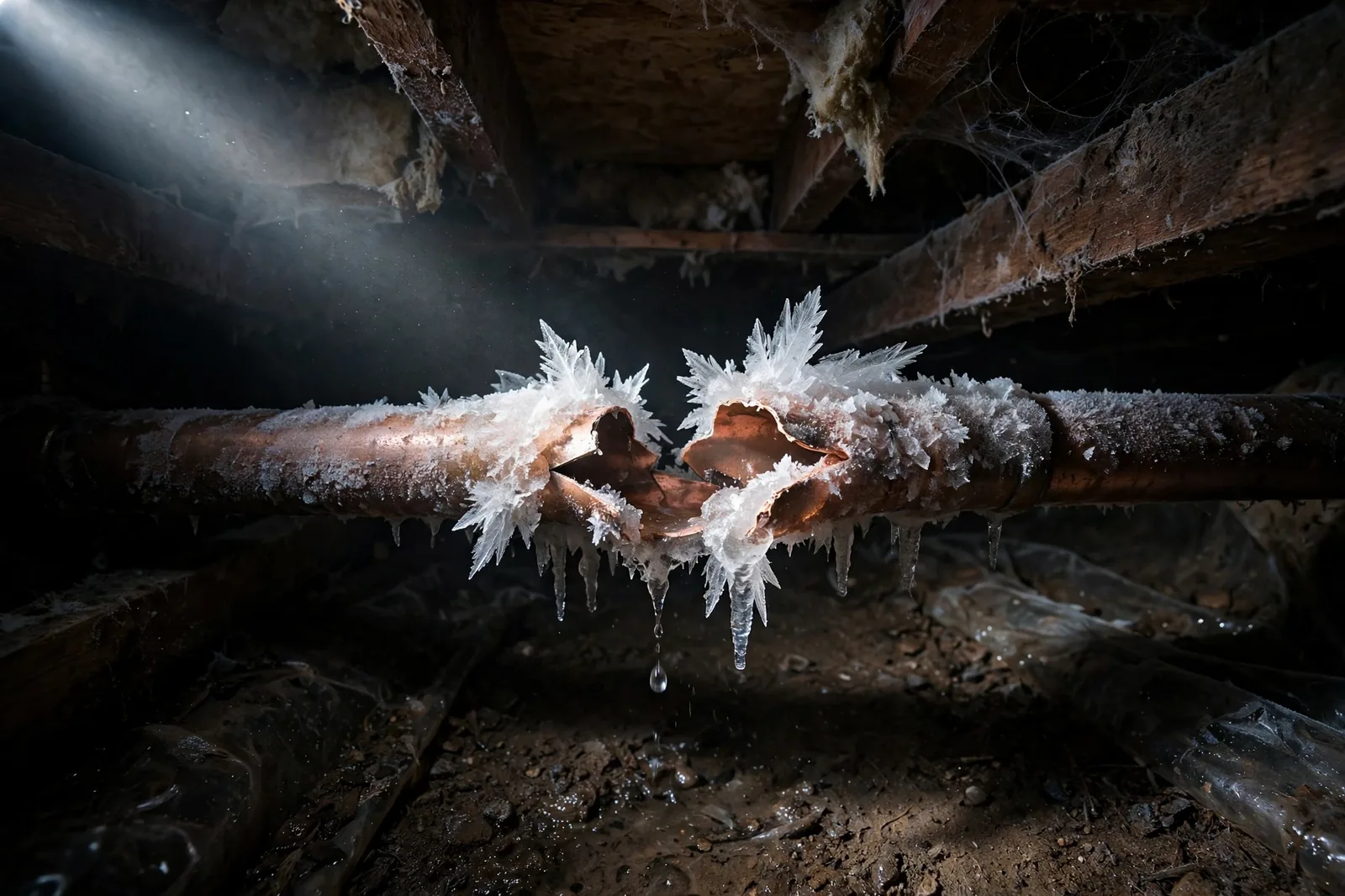
FROZEN PIPES • MIDVALE, UTAH
How to Keep Pipes From Freezing in Midvale, and What to Do If One Bursts
To keep pipes from freezing in Midvale, insulate pipes in crawl spaces, garages and outside walls, disconnect garden hoses before the first hard freeze, keep the heat steady at night, and let a faucet drip during the coldest spells. If a pipe bursts, shut off the main valve first, then deal with the water.
At what temperature do pipes freeze in Midvale homes?
Exposed pipes can freeze once outdoor temperatures stay below about 20°F for several hours, especially in crawl spaces, garages and outside walls.
The number on the thermometer is only part of it. What matters is how cold the pipe itself gets and for how long. A pipe in a heated room rarely freezes. A pipe in an uninsulated rim joist, a garage wall or a crawl space near a vent can freeze on a night that doesn't feel especially cold, because wind and cold air reach it directly. In the Salt Lake Valley, cold air can also settle on the valley floor for days at a time during winter inversions, so homes in Midvale can sit through long stretches of below-freezing nights. The longer the cold lasts, the more pipes are at risk.
Where Midvale Pipes Freeze First
Every home is different, but these are the spots that freeze most often in Midvale:
- Rim joists: the band of framing where the floor sits on the foundation. Pipes running along it in basements get cold air from outside.
- Cantilevered floors: in many 1960s to 1980s split-levels around Hillcrest and Union Park, part of the floor hangs past the wall below, with pipes inside.
- Garage walls and ceilings: supply lines running through an unheated garage to a kitchen or bathroom.
- Crawl spaces: common in older homes near Historic Main Street and Center Street, often with old galvanized lines.
- Outside walls: kitchen sinks and bathrooms on exterior walls, especially with cabinets that block warm air.
- Hose bibs: outside faucets, especially with a hose still attached.
- Swamp cooler water lines: small lines running to rooftop coolers that weren't shut off for winter.
If you know where your pipes run, you know where to focus.
Why the Hose Bib Matters So Much
Many outside faucets are designed so the shut-off sits inside the wall where it stays warm. But when a hose is left connected, water stays trapped in the faucet body. That water freezes, splits the pipe inside the wall, and you won't see anything until spring, when you turn the faucet on and water runs into the wall or basement instead of out the spout. Disconnecting hoses in fall is one of the easiest ways to prevent a hidden burst.
How to Keep Pipes From Freezing: A Midvale Checklist
Before the first hard freeze (usually October):
- Disconnect and drain garden hoses.
- Shut off and drain any outside faucets that have separate inside valves.
- Shut off and drain the swamp cooler water line.
- Drain and blow out sprinkler systems.
- Insulate exposed pipes in crawl spaces, garages and along rim joists.
- Seal gaps where cold air gets in near pipes, especially around sill plates and pipe penetrations.
- Close crawl space vents.
- Find your main shut-off valve and make sure it turns.
During cold spells:
- Keep the thermostat steady day and night, at least in the mid-60s.
- Open cabinet doors under sinks on outside walls.
- Let a faucet on an outside wall drip slowly overnight.
- Keep the garage door closed if pipes run through the garage.
- If you travel, leave the heat on and ask someone to check the house.
Signs a Pipe Is Already Frozen
- Little or no water comes out of a faucet when you turn it on.
- Frost on a visible pipe.
- A faucet works on one side of the house but not the other.
- A strange smell from a drain, as air can't move through the line.
If you see these, assume the pipe may already be split, even if nothing is leaking yet. The leak usually starts when it thaws.
How to Thaw a Frozen Pipe Safely
- Shut off the main water valve first if you suspect a split, so thawing doesn't start a flood.
- Open the faucet the pipe feeds, so water and steam can escape as it thaws.
- Warm the pipe gently with a hair dryer, a heating pad, or a space heater kept at a safe distance. Start nearest the faucet and work back.
- Never use an open flame like a torch or lighter. It can damage the pipe and start a fire inside the wall.
- Check for leaks as water starts moving again. If water appears in a wall, ceiling or floor, shut the main off again.
- Call a plumber if you can't reach or thaw the pipe, or if it's inside a wall.
What to Do in the First 15 Minutes After a Burst
If a pipe bursts, speed matters more than anything else.
- Shut off the main water valve. In most Midvale homes it's in the basement or utility room where the water line enters, often near the water heater.
- Turn off power to wet rooms at the breaker, if you can reach it without standing in water.
- Open a faucet on the lowest floor to drain pressure from the lines.
- Move belongings out of the water: rugs, electronics, furniture, boxes.
- Take photos and video of the water, the damage and the broken pipe.
- Call a plumber to repair the pipe.
- Call a water damage crew at (385) 337-3560 to remove the water and dry the structure. Burst Pipe Water Damage
Why Burst Pipe Damage Spreads Inside Walls
A split pipe inside a wall doesn't just leak onto the floor. Water runs down the inside of the wall cavity, soaks the insulation, pools on the bottom plate and spreads under flooring into the next room. The drywall face may look dry while the inside stays wet. That's why burst pipes need more than a mop and a fan: moisture meters and thermal imaging show how far the water went, and drying has to reach inside the wall cavity. Emergency Water Extraction
Does Insurance Cover Frozen Pipes in Utah?
Most Utah homeowners policies cover sudden water damage from a pipe that froze and split. They usually don't cover the repair of the pipe itself, damage from a slow leak that went on for a long time, or damage in a home that wasn't kept heated. Policies vary, so check yours. Photos, dates and records of when the leak was found help your claim either way.
Frozen Pipes in Midvale Rentals and Condos
More than half of Midvale homes are rented, and many sit in multi-unit buildings. Vacant units between tenants and units with the heat turned down for travel are the most likely to freeze. A burst in one unit can damage the units below and beside it. Landlords and property managers should keep heat on in empty units and check them during cold spells. Tenants should tell their manager right away if water pressure drops during a freeze. Condo & Apartment Water Damage
Which Midvale Homes Are Most at Risk
| Home type | Common weak spot | One fix that helps most |
|---|---|---|
| Older bungalows near Historic Main Street | Galvanized lines in crawl spaces | Insulate crawl space pipes and close vents in winter |
| 1960s to 1980s split-levels in Hillcrest and Union Park | Pipes in cantilevered floors and rim joists | Insulate and air-seal rim joists |
| Ramblers with attached garages | Lines through garage walls | Keep the garage door closed in cold snaps |
| Townhomes and condos in Bingham Junction and Jordan Bluffs | Lines near exterior walls, sprinkler lines in cold spaces | Keep units heated, even when empty |
| Any home with an outside faucet | Hose left attached | Disconnect hoses every fall |
About 43% of Midvale homes were built before 1980, so original pipes and older insulation are common. If your home is in that group, an hour of prep in October can prevent the most common winter calls.
Water Leak Alarms: A Cheap Early Warning
Battery water-leak alarms cost little and sit on the floor near water heaters, washing machines, sinks and in basements. Many connect to your phone, so you get a warning while you're at work or traveling. Some systems can even shut off the main water valve automatically when a sensor gets wet. For homes with finished basements or rentals that sit empty between tenants, they're one of the simplest ways to catch a burst before it spreads.
Frozen Pipe FAQ
Should I leave faucets dripping every night in winter?
Only during the coldest stretches, and only on faucets connected to pipes along outside walls or in cold spaces. A slow drip keeps water moving.
Can PEX pipes freeze?
Yes. PEX flexes more than copper, but fittings and connections can still split when water inside freezes.
How do I find my main water shut-off?
Look where the water line enters the house, usually in the basement or utility room near the water heater. In homes without basements, check a crawl space, garage or front closet.
What if a pipe bursts while I'm away?
That's why keeping the heat on and having someone check the house matters. Water leak alarms near the water heater and in the basement can also alert you on your phone.
Is a frozen pipe an emergency if it hasn't burst?
Treat it as one. Shut off the water to that line if you can, and thaw it carefully before it splits.
Pipe Burst in Your Midvale Home?
If a pipe has already split and water is in your walls, ceilings or floors, call (385) 337-3560. A crew is dispatched immediately to remove the water and dry your home before the damage spreads.